
2026 March – 01
The OODA Loop: Applying John Boyd’s Framework to Self-Defence and Everyday Life
By Alan Mann — www.learn-krav-maga.co.za
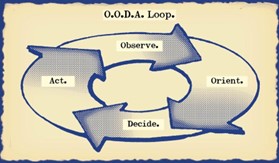
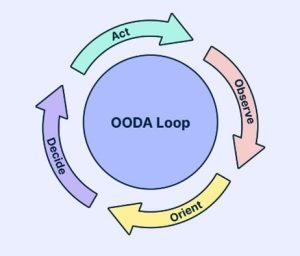
In a world defined by rapid change and constant uncertainty, the ability to make clear, timely decisions is invaluable. One of the most influential frameworks for achieving this is the OODA Loop, developed by a military strategist, Colonel John Boyd. Though originally designed for aerial combat, its principles extend seamlessly into ground combat, self-defence, personal development, and professional life.
This article explores how the OODA Loop works and how it can be applied to improve awareness, decision-making, and adaptability in everyday situations.
What Is the OODA Loop?
The OODA Loop is a continuous cycle consisting of four stages:
- Observe – Gather information from your surroundings
- Orient – Interpret that information using context and experience
- Decide – Select an appropriate course of action
- Act – Execute the decision
Rather than a one-off process, it is a dynamic loop. Each action generates new information, feeding back into observation. The aim is to obtain resolution / dominance, victory, through speed, knowledge, adaptability, and continued learning.
Applying the OODA Loop to Self-Defence
Self-defence situations demand rapid thinking under pressure. The OODA Loop offers a mental model, that is practical, to assist you in remaining composed and effective during action.
Observe: Remain Situationally Aware
Awareness is your first line of defence. This includes:
- Monitoring people and their actions and behaviour, near and around you
- Noticing environmental changes
- Identifying potential risks early
For instance, recognising erratic and unusual behaviour in a public space allows you to act before a situation becomes difficult to resolve.
Orient: Understand the Situation and move into a ‘position’ that is more advantageous
Interpret what you see:
- Does your position reduce your risk of danger or move you closer to resolution / dominance?
- What are your escape routes?
- Are there others nearby who could be a hindrance or could possibly assist?
Your instincts, past experiences, and training shape this stage.
Decide: Choose the Best / Safest Option to Act
Possible responses include:
- Avoidance (changing direction or location / position)
- Verbal de-escalation
- Physical defence, if absolutely necessary
The priority is always personal safety and disengagement.
Act: Commit and Adapt
Act decisively:
- Hesitation can increase vulnerability
- Confidence can deter aggression
Once you act, you immediately begin observing again, adjusting to any changes. The OODA loop continues and repeats
Applying the OODA Loop in Personal Life
Beyond high-pressure scenarios, the OODA Loop is highly effective in everyday decision-making.
Observe: Be Present
Pay attention to:
- Your emotions and reactions
- Relationships and social dynamics
- Opportunities and challenges around you
Mindfulness plays a key role here.
Orient: Reflect and Understand
Ask yourself:
- Why do I feel this way?
- What patterns am I noticing?
- What assumptions might I be making?
This stage encourages self-awareness and critical thinking.
Decide: Make Intentional Choices
Whether it’s managing time, resolving conflict, or setting goals:
- Avoid impulsive reactions
- Choose responses aligned with your values
Act: Follow Through
Execution builds confidence and momentum. Even small, consistent actions can lead to meaningful change over time.
Applying the OODA Loop in Professional Life
In the workplace, the OODA Loop becomes a tool for agility, leadership, and strategic thinking.
Observe: Stay Informed
Keep track of:
- Industry trends: This is a function involving the Marketing (surveys) and the Executive Divisions (analyses)
- Team performance: via statistical analysis on data gained on individuals / departments KPI’s
- Customer needs
Effective professionals are always scanning their environment.
Orient: Analyse and Align
Interpret the information:
- How does this affect your role or organisation?
- What opportunities or risks are emerging?
Collaboration and diverse perspectives can improve this stage.
Decide: Act with Clarity
Examples include:
- Prioritising tasks
- Making strategic recommendations
- Responding to challenges
Good decisions balance speed with insight.
Act: Execute and Learn
Act and evaluate outcomes:
- What did work?
- What did not work?
- What can be improved in the future?
Continuous learning keeps the loop effective.
Why the OODA Loop Matters Across All Areas
The true strength of the OODA Loop lies in its universality. Whether facing a physical threat, navigating personal challenges, or making professional decisions, the same principles apply:
- Awareness creates opportunity
- Understanding shapes better decisions
- Speed and adaptability create advantage
Those who can move through the loop efficiently are better equipped to handle uncertainty and change.
Practical Ways to Strengthen Your OODA Loop
To apply this framework effectively:
- Develop awareness – Practise observation in daily life
- Challenge assumptions – Improve how you interpret situations
- Simplify decisions – Avoid unnecessary complexity
- Act decisively – Build confidence through action and reflection
Conclusion
John Boyd’s OODA Loop is far more than a military concept…. it is a powerful framework for navigating modern life. From self-defence to personal growth and professional success, it equips individuals with the tools to think clearly, act decisively, and adapt continuously.
In an unpredictable world, the ability to observe, orient, decide, and act effectively is not just an advantage…..it is a necessity.
 In this above detailed diagram, there is ONE word that indicates the understanding of this whole concept, which one is it? Let me know.
Where do you see total understanding (and what makes this phase so important), taking place?
How does the OODA Loop tie in with Sun Tzu – The Art of War?
ATTACK BY STRATAGEM
Hence the saying: If you know the enemy and know yourself, you need not fear the result of a hundred battles.
If you know yourself but not the enemy, for every victory gained you will also suffer a defeat. If you know neither the enemy nor yourself, you will succumb in every battle.
Hence the saying: If you understand the problems, you encounter and know that you have trained and understand the protocols and solutions to these, you need not fear the result of a hundred issues.
If you know the problems you encounter but not the protocols and solutions to these, for every issue solved you will also suffer a defeat.
If you know neither of these, you will succumb to every issue.