
Structuring Self Defence for South Africa’s Realities
Structuring Self‑Defence for South Africa’s Realities
Violent crime in South Africa continues to evolve, moving closer to towns and communities once considered safe. Criminals are increasingly brutal, and the effects of Covid‑19 have only intensified this trend. In this environment, self‑defence training must adapt to realities on the ground.
At our Krav Maga dojos and training venues, we recognize that awareness, profiling, avoidance, and vigilance are essential. Locking doors, installing electric fences and motion detectors, training dogs to bark, maintaining awareness while driving, stopping a car length behind the vehicle in front, reverse parking for safer exits, and double‑checking locks after activating alarms – these are all measures that can prevent confrontation. If applied consistently, they may mean you never need to use self‑defence techniques.
Yet, awareness alone is not enough. If precautions fail, or if one is caught unawares, individuals find themselves in what we call the RED and BLACK zones – moments of immediate danger where survival depends on decisive action. This is where our Krav Maga system differs: we do not train to fight; we train to finish the fight.
Simplifying Defence Against Weapons
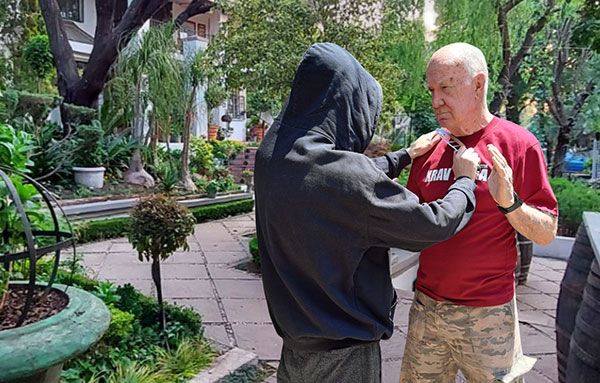
Research by Patrice Bonnafoux on knife attacks has been invaluable in shaping our methodology. His statistical analysis of how knives are held and used reduces confusion and helps students respond more effectively under pressure. By categorising grips, stabbing methods, and attack scenarios, we can narrow down defensive responses to what is most practical.
For example, knives are effectively held in three distinct ways, and stabbing occurs in two primary methods. While variations exist in speed, angle, and intensity, recognising these fundamentals allows students to eliminate unnecessary techniques and focus on what works.
From this foundation, I have developed seven facets of knife and gun attacks – a framework that accelerates learning and improves ‘precision’, even though we use gross motor movements throughout our techniques. Students are better prepared to defend themselves successfully against weapon threats.
Strategic Thinking in Self‑Defence
Drawing inspiration from Sun Tzu and John Boyd, I approach self‑defence from the perspective of a combat soldier operating in extreme danger. Every victim of crime is, in that moment, a soldier in the red and black zones. Strategic thinking is therefore essential.
A simple observation such as “How is he holding the weapon?”, immediately reduces the number of possible defensive responses. This clarity is critical when assaults occur closer, faster, more suddenly, and with more power than most people believe.
Awareness vs. Action
There is ongoing debate about whether awareness and avoidance are sufficient. Some argue that if precautions are properly applied, self‑defence techniques may never be needed – except in unavoidable situations. While I agree that vigilance is vital, I believe it must be paired with structured training. Awareness without action leaves gaps; training ensures those gaps can be closed when danger strikes.
Conclusion
Our goal is to create a more structured, practical, and effective system of self‑defence suited to South Africa’s realities. By simplifying weapon defence, reducing confusion, and incorporating strategic thinking, we prepare students not only to survive but to prevail.
In a country where crime is closer and more brutal than many imagine, self‑defence must be more than theory. It must be a system that finishes the fight.